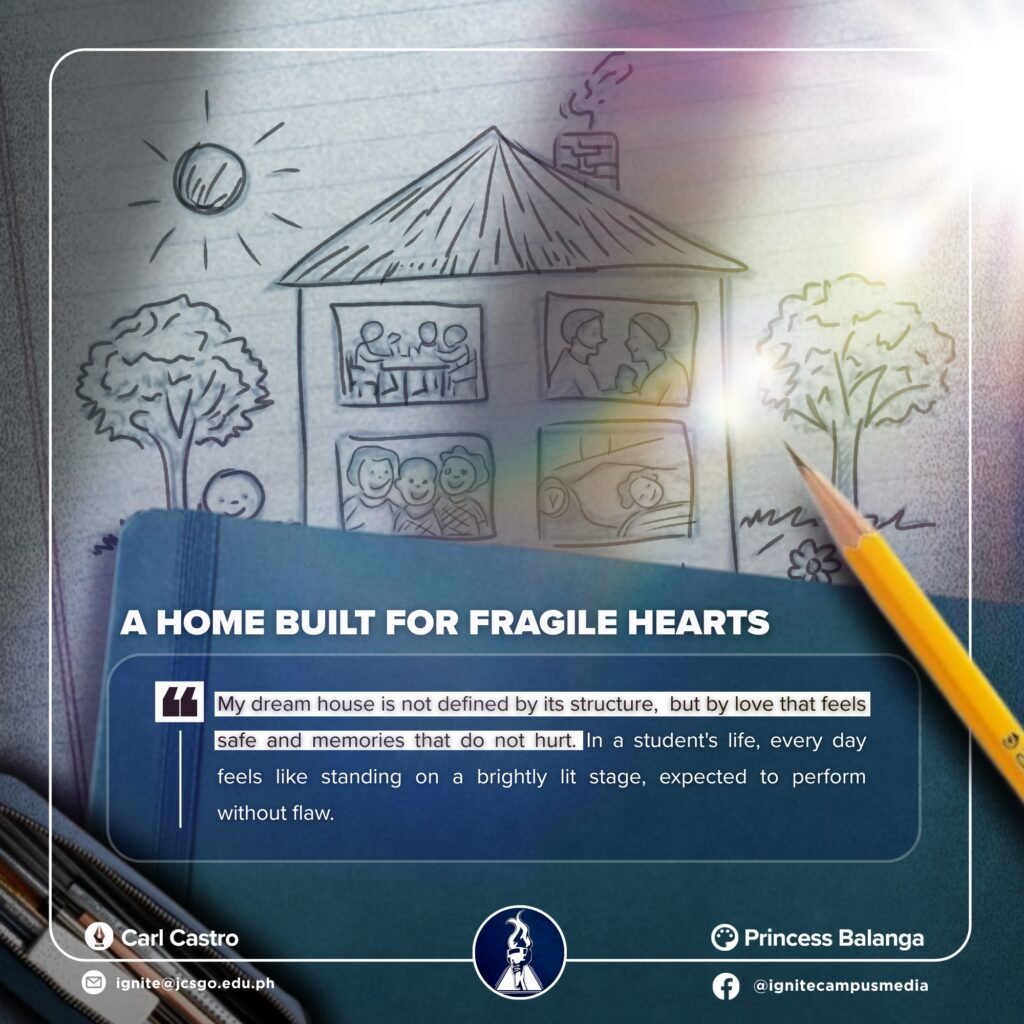
A home built for fragile hearts
A home built for fragile hearts
| Carl Castro
Four chairs stood around the dining table, but no one sat down. The television hummed softly in the background while a clock ticked somewhere in the house, counting seconds no one seemed to notice. A plate remained untouched. A glass of water sat half-full. The room was complete with walls, a roof, furniture, and everything that should have made it feel like a home.
Back in childhood, we were often asked a simple question: “What is your dream house?”
Simply, we dreamed of having our own room with colorful designs, a gaming space, and a big, spacious house where everything felt fun and exciting. We imagined a home full of laughter, where friends could stay longer, and every day felt light, happy, and full of play.
Yet somehow, it didn’t feel like enough. Everything looked complete, yet the most important part—belonging—was missing.
But if I were given the chance to answer that childhood question today, my answer would look less like a blueprint and more like a confession:
My dream house would have a cozy kitchen where no one is shouted at over small mistakes, like a spilled glass of water or a burned meal. It would have a staircase where no one sits alone in the dark, knees drawn close, listening to arguments echoing below. I want a dining table where everyone shares meals without judgment—only quiet conversations about how each day has been. And I want a bed where people sleep, not to hide, simply because they are tired. My dream house is not defined by its structure, but by love that feels safe and memories that do not hurt.
Suddenly, I found myself staring at the wall of our house, lined with certificates and medals. Everything feels lighter there. Back then, I reached for them out of my own wanting — not because I had to, but because I truly chose to.
In a student’s life, every day feels like standing on a brightly lit stage, expected to perform without flaw. As a student leader, I know this all too well—we are told to stay strong, smile through pressure, and never break. But there are moments when even the strongest cracks. Just last school year, after a heavy week of quizzes and tasks, I found myself inside a bathroom cubicle during break time, silently crying after seeing an unexpected quiz score that made my world feel like it had suddenly collapsed.
This situation lingers in my mind that being a leader meant I had to look strong — even when I was quietly falling apart.
Some people are good at hiding their sorrow—just because they carry it well, that doesn’t mean it’s not heavy.
Then all at once, clarity came to me—was I truly striving for excellence, or only running from the disappointment of those around me?
Somehow, I found I had no heart left to celebrate small wins or even great milestones—they no longer felt like achievements.
Instead, everything felt like nothing more than an obligation I had to fulfill.
It is incredibly easy to tie your entire self-worth to the marks on a report card or the titles attached to your name. This heavy burden is a reality shared by many Filipino students. This point is supported by a study that reminds us that family hopes and academic performance are deeply intertwined, turning school pressure into something the whole household feels.
This is why a true home becomes so important. It is a place where mistakes are not treated like crimes, but like a natural part of growing up. This made me realize that you can have everything a house needs, and still be homeless in your own heart.
In class, even raising your hand can feel heavy. Your heart beats faster, afraid of the whispers that may follow if your answer is wrong. According to a study by Pascua & Maramag, it described this quiet fear shared by many Filipino students—the fear of failure and the pressure of judgment that often keeps young minds from speaking freely.
But in the right space, that fear slowly fades. It becomes a place that listens before it reacts, a place that understands before it judges. A gentle refuge where voices are not silenced, but softened. And in that kind of home, you no longer need to pretend that you have everything figured out.
Beyond the relief of escaping judgment, this space also changes how we see ourselves. Too often, we are only celebrated when we hold a trophy. We live in a culture where a student’s worth is tied to high grades. But a nurturing environment acts as a shield; in line with Mental Health Philippines, a safe, home-like space protects young people from anxiety, self-criticism, and emotional storms. In this true home, the pressure to perform disappears. You do not need a medal or a perfect report card just to be told that you are enough.
We dream of a home that offers the ultimate luxury: the freedom to be weak. At school, the rule is to stay sharp, stay ready, stay perfect. But the moment you step through that door, you can finally let your guard down. Even in your quietest, most fragile moments, you are safe. It is a home with an open heart, where you can speak your truth—through tears after a hard day, worries about the future, or dreams you are too afraid to say out loud.
It is also a home that teaches patience and acceptance. Differences in learning, in thinking, and in talent are not treated as burdens or disappointments. They are seen as part of what makes each person human. We learn to value quiet moments, to be gentler with ourselves, and to find peace not out of fear of failing others, but out of genuine love.
A real home is not defined by its square footage, its design, or the number of floors it has. It is felt in shared laughter in the hallway, in comforting silence when words are not enough, in tears that are never judged, and in stories told after long, exhausting days.
When the final school bell rings and the weight of the world settles once again on your shoulders, ask yourself:
Are you going back to just a house, or are you finally going home?