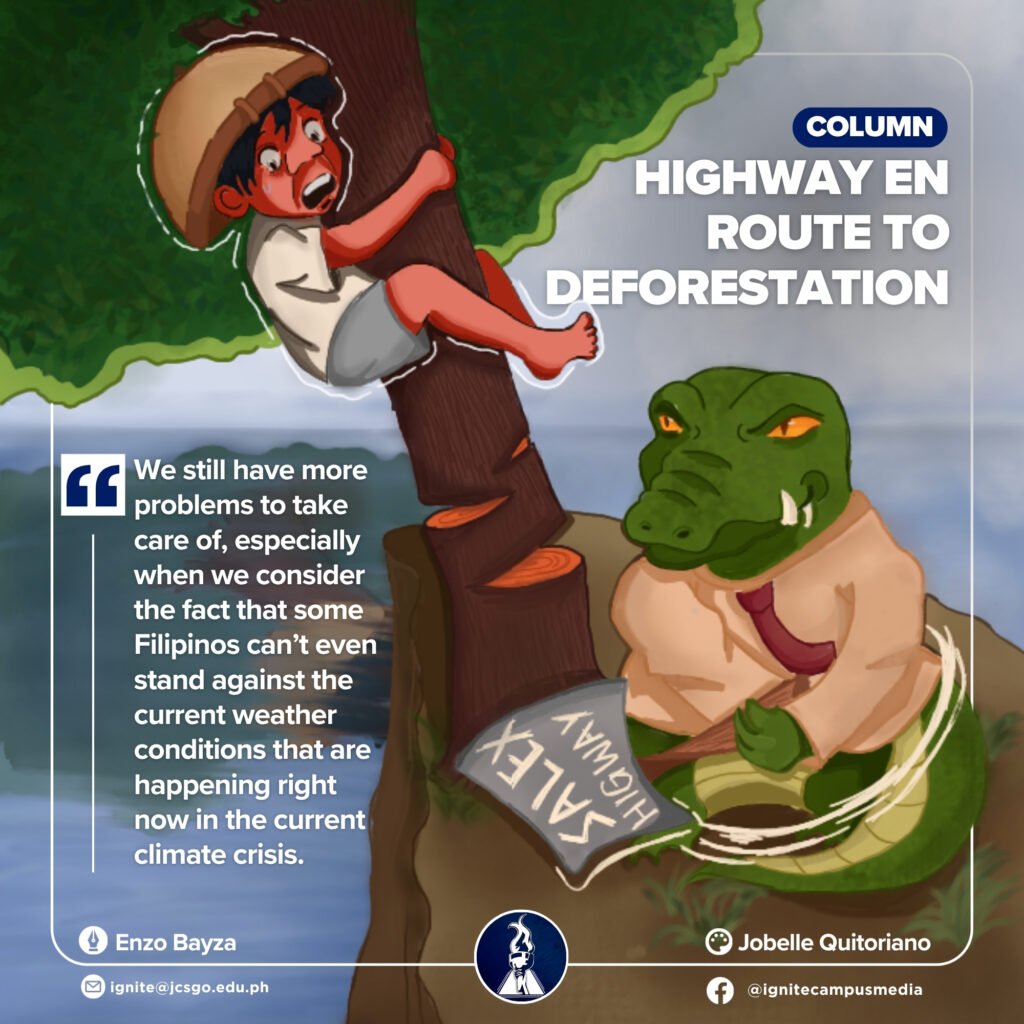
Highway en route to deforestation
Highway en route to deforestation
| Enzo Jacob Baysa
Some say that a Narra tree bleeds once cut. Now imagine that, but with 600 trees, just to make a highway. That thought might just become reality when the Department of Environmental and Natural Resources (DENR) allows the mass cutting of over 600 trees in Quirino Avenue to begin construction of the Southern Access Link Expressway (SALEX).
The department stated that the SALEX was made to connect the Skyway to Roxas Boulevard — their solution to the worsening traffic congestion within Metro Manila.
However, this decision faced backlash from several critics and environmental groups, claiming that the construction will only make traffic congestion worse. In order to control the backlash, the DENR attempted a few measures to “make up” for the mass cutting. Such as suspending the cutting of trees and planting 50,700 saplings across Manila, as well as baling some of the younger, healthy trees. Although the DENR has settled some measures regarding the mass cutting, there are also other factors and concerns that we need to consider regarding the construction of SALEX.
The Philippine Atmospheric, Geophysical and Astronomical Services Administration (PAGASA) announced that an upcoming habagat season with intensified rainfall and possible flooding will be expected for the following months to come, with the heat of the dry season still for a few weeks.
If the majority of the trees and greenery are gone, the roads of SALEX will nearly guarantee the collapse of the highway as the trees and greenery act as protection against flooding and landslides. Considering that floods and landslides during the habagat season already deal major damage to existing infrastructure, adding an unstable and questionable expressway will deal even more damage if said expressway collapses, kind of like a domino effect. And this outcome will worsen once the trees get cut down. It’s essentially asking to ruin nearby areas once the SALEX breaks down eventually.
Instead, planning to make an entirely new highway furthers traffic problems; it’s better to fix the current transportation system that tends to cause traffic congestion. Some solutions include implementing High-Occupancy Vehicle (HOV) lanes to reduce single-occupant vehicle trips, tracking traffic volumes to reduce accidents, or even enhancing train and bus transit systems to reduce the reliance on private vehicles, which could actually benefit the traffic problem more than building an entirely new highway with questionable stability.
And to add onto everything, a throwback to SONA 2025 had President Ferdinand “Bongbong” Marcos Jr. condemning the flood control projects. “Mahiya naman kayo.”
But that was a year ago, so what’s changed? Did we at least have some decent progress? Maybe, since an investigation on said flood control projects had commenced shortly after the address, uncovering countless discrepancies (over 6,000 from July 2022 to May 2025) from 11 of the top 15 flood control contractors, along with the ghost projects’ budget getting allocated for actual use.
Considering all of these factors from the SONA 2025, this further raises many concerns about the construction of the SALEX. Such as the uncertainty of whether floods will still happen or not in certain communities near the SALEX, though the government has already taken some measures of the flood control scandals. A few are the ongoing investigations into the flood control scandals, and freezing the accounts of those associated with the ghost projects.
We still have more problems to take care of, especially when we consider the fact that some Filipinos can’t even stand against the current weather conditions that are happening right now in the current climate crisis.
Environmental Advocates had raised this concern to the DENR, warning that the continued deforestation for the SALEX highway extensions will only worsen the extreme heatwaves we are currently experiencing in the Philippines.
Trees provide a canopy cover and shade for pedestrians; these trees are especially important during the summer, when the temperature reaches its peak. Without them, communities located near the SALEX will experience extreme heatwaves if the mass cutting continues. Casualties are possible even if the climate gets severe enough.
Sure, the DENR did compensate for the tree cutting, but is it even guaranteed that all of the saplings will sprout? Even if they sprout, we have to wait for them to grow into trees. Growing trees will take years, or even decades, for the trees to fully grow.
In the meantime, what will the people use for protection now that the 50-year-old trees have been cut down? People will have to wait for at least 10 years to provide a decent amount of shade.
These concerns regarding the DENR’s construction of SALEX had already sparked a lot of attention with its controversial methods, such as deforestation.
To push back on this project, we can spread awareness of the effects of SALEX’s completion, and at least give the DENR an idea of what will actually happen when the SALEX project actually finishes.
As citizens of the Philippines, we must voice our concerns for our safety and against the uncertainty of the completion of SALEX’s effects. If not, then the highway will almost guarantee the ruin of the communities and environment around it.