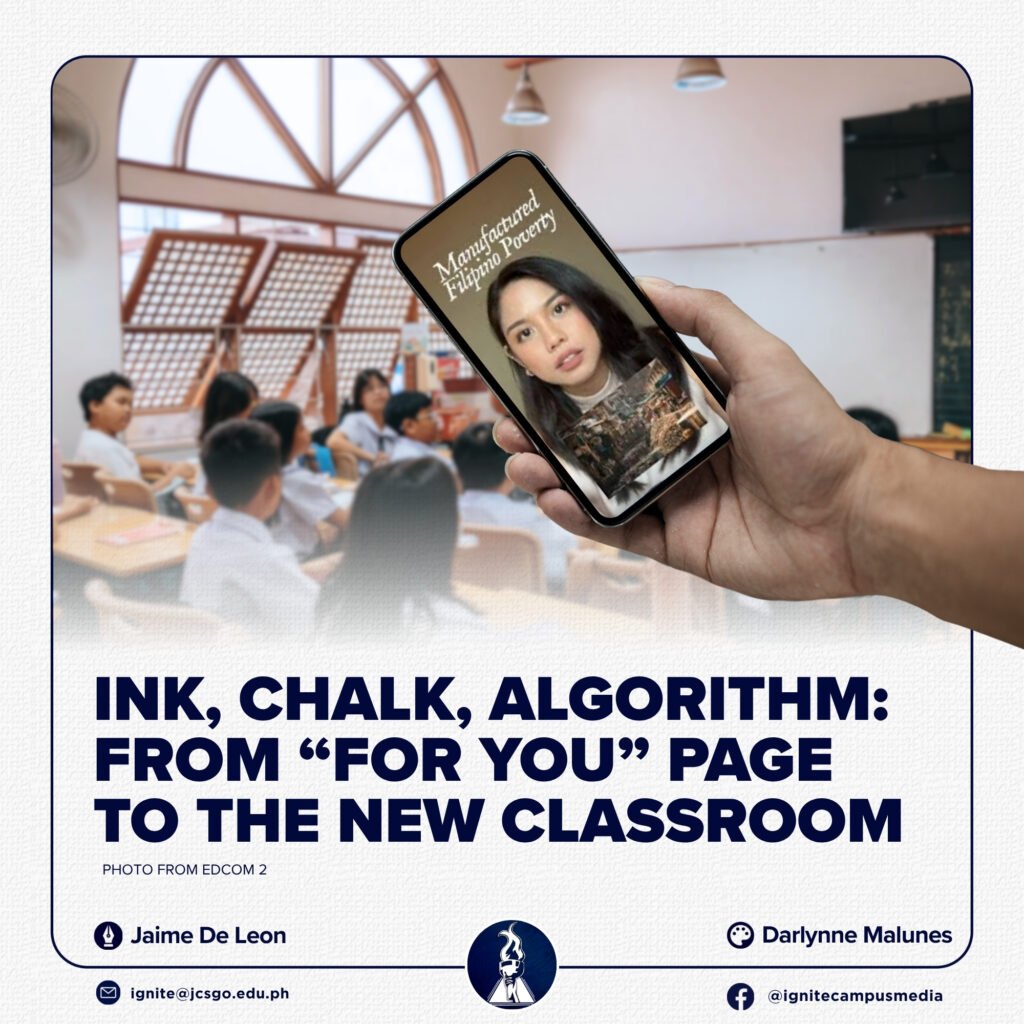
Ink, Chalk, Algorithm: From “For You” page to the new classroom
Ink, Chalk, Algorithm: From “For You” page to the new classroom
| Jaime De Leon
Learning once had an address. It lived on ink stuck to paper, chalk dust moving across a board, and it had lived inside classrooms where it had been built.
Nowadays, that address has expanded. Lessons no longer arrive just through textbooks, classrooms, and classroom walls. But, they now also appear through screens.
One swipe, a dance trend. Then another, a cooking recipe. But on the next scroll, a creator breaks down a complex calculus formula in a fast-paced 60-second video, or maybe even explains 4,000 years’ worth of history, all in a small video.
For years, social media has often been viewed by parents and educators as a source of distraction rather than a learning tool. Concerns over excessive screen time, shortened attention spans, and procrastination have led many to associate smartphones with academic difficulties rather than educational opportunities.
But the irony is, the “For You” pages that were once dismissed as a black hole of wasted time, what used to be just a source of quick entertainment, are slowly becoming a personalized learning space.
The cause of this shift is a concept known as “Edutainment,” a combination of the words education and entertainment. Edutainment is more than just a catchy word; it is a strategic way of conveying information through content meant to engage, entertain, and educate all at the same time.
Their success in this concept raises a simple, important question: “Why does this work so well?” The answer may lie in how students nowadays handle information.
Look past textbook definitions and step into a student’s shoes. Picture a Tuesday Morning: A teacher stands in front of a humid classroom, explaining the study of animal biology. The air is thick, jargon everywhere—the chalkboard has faint chalk dust off of mathematical formulas, and by minute 30, the fog of mental fatigue is all over the room.
Yet the same student is later completely transfixed by a 60-second video about how mammals can live. Same exact topic, yet it made everything click. The information is not necessarily any different; it was merely delivered into a format that the student feels approachable.
Its impact can be seen in a student’s personal experiences. A learner reviewing for a science examination might find themselves indulging in a creator’s video simplifying the difficult lesson through visual and appealing content. Another review for a History quiz may include videos showcasing historical events through animation.
This biological hack is supported by data itself. According to a February 2025 study on TikTok’s educational system published in the International Journal of Social Sciences and Management Review, it found that short-form applications and platforms function as powerful learning spaces, using personalized algorithms to spark student interest and expose them to self-directed learning.
This principle can be seen anywhere: students sharpen their vocabulary through Roblox Spelling games, others solve mathematical problems through the game Math Antics, and Geography enthusiasts find themselves hunting and learning in GeoGuessr. Learning becomes woven into something that they already enjoy.
Although the rise of Edutainment has its concerns and issues. The same 2025 study warns that it has its own downside too.
Short-form content can encourage superficial understanding. Complex scientific discoveries, long historical events, and social issues are often put into short clips, leaving no room for nuance, meaning important details can also be lost.
Misinformation even presents a greater challenge. Without traditional teaching from teachers who know how to gatekeep this issue, presentation can sometimes outweigh accuracy. A convincing voice, good editing, and appealing visuals can all lead to spreading misinformation.
Beyond the surface-level learning and fake facts seen, edutainment hits a wall: the digital division. The success of this concept completely relies on having great technological infrastructure, completely trapping its benefits in rural areas. In rural and unprivileged areas, lack of digital access, internet, and basic technical support completely rinses the thought of edutainment.
This essentially turns the algorithm on its head, driving tools that usually cause students to learn more. This strategy has proven popular among many Filipino content creators.
Nikka C. Gaddi focuses on issues that tend to be left unspoken, educating her audience about public transport, urban planning, and community development.
Mona Magno-Veluz, meanwhile, uses a combination of history and genealogy, and even something she calls “ninuno-hunting” to educate her audience by connecting them with their heritage.
And for Eulah Araullo, a simple question is all it takes. Why is the seal of Quezon City a triangle? Who designed the passport of the Philippines? Using her curious nature to explore and study more aspects of Filipino culture.
One thing these individuals have in common: Facts and information are not enough to engage an audience. Stories do. Curiosity does. Wonder does.
Ultimately, edutainment is not trying to replace real teachers or actual studying. It will not grade your research papers for you, and it cannot give you the deep guidance and criticism you need.
Perhaps that really is the irony of modern education. The one thing that teachers and parents would pull students away from and blame for the status of the students’ grades, is also the stepping stone of various successful, smart students.
Because sometimes, knowledge is not just passed through classrooms; Sometimes, they arrive one swipe at a time.