Unshakeable grit
Unshakeable grit
| Hale Capili
Our resilience keeps us moving, but we shouldn’t romanticize tolerating an inadequate transportation system.
Sometimes, getting home may be more exhausting than anything else. After countless hours of school or work, a commuter faces an even more daunting task: the long, torturous wait for a vehicle, whether it be a bus, jeepney, or any other means of transportation.
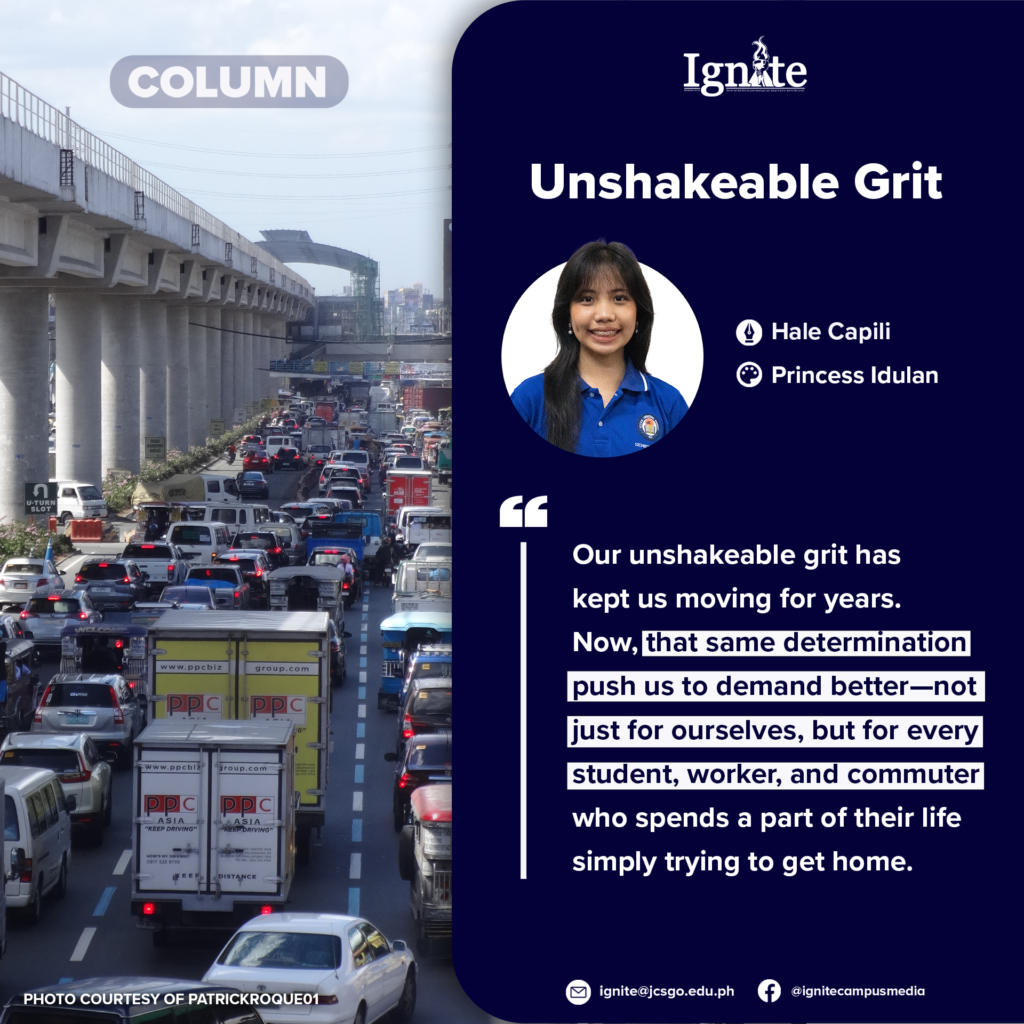
They endure long lines of waiting commuters, already-filled buses, jeepneys, and traffic jams. This is a disappointment and a burden Filipinos bear.
According to a 2022 survey by a transport advocacy network, The Passenger Forum, 79% of respondents agree that their waiting time to get a ride is usually too long. Meanwhile, 96% disagree that the number of public utility vehicles (PUVs) on the road, including both jeepneys and buses, is enough to serve commuters.
I sometimes have to leave early just to get to class on time. When classes end, getting back is another struggle—I have to wait for transportation, then squeeze into a crowded vehicle before finally reaching my destination. By the time I arrive, the commute has already drained much of my energy.
As a student, I know I’m not alone. Many of us rely on public transportation. We can’t just drive to school. We have to adapt to a system that doesn’t have enough PUVs for people who use them.
Filipino commuters face a severe Metro Manila transport crisis driven by chronic PUV shortages, long wait times, and overloaded infrastructure.
Now, commuters are being asked to pay more for that same system. The Department of Transportation (DOTr) approved fare increases for public utility vehicles, with the new rates taking effect on Monday, September 28.
Traditional jeepney fares increased from P13 to P14 for the first four kilometers and an additional P2 for each succeeding kilometer. Meanwhile, modern jeepney fares rose from P15 to P17, plus P2.40 for every succeeding kilometer.
Our jeepney drivers are not to blame for the price hike; they are just trying to survive, barely scraping enough to feed their own families. For commuters who depend on public transportation every day, even a few pesos will eat away at their money over time—a price to pay for the rising costs of living in the Philippines.
For those who cannot afford a more private commute option, public transport becomes a necessity. They pay the price with their time, comfort, safety, energy, and now, even higher fares. A country so dependent on commuters should provide accessible transportation. Filipinos can be resilient while still demanding better conditions.
This doesn’t mean we should simply learn to endure problems that need addressing. We should not strengthen our endurance to survive a broken system; we should be given a system that makes our journey easier.
Our unshakeable grit has kept us moving for years. Now, that same determination should push us to demand better—not just for ourselves, but for every student, worker, and commuter who spends a part of their life simply trying to get home.
We need better, faster, and accessible public transportation.
We have the strength to keep moving. Now we need a system that moves with us. We are overtaxed but underserved; if you’re still not mad, why?
We have made a virtue out of our endurance, complaining about the long waits but never complaining loudly enough to change a system that makes our lives this way. The years of making this a virtue of putting up with it are enough.
We need a public transportation system that serves all. We need lawmakers who understand that a system should serve the best interests of the working class, women, and the less privileged. We need to stop making endurance a virtue and start demanding a better way of life.