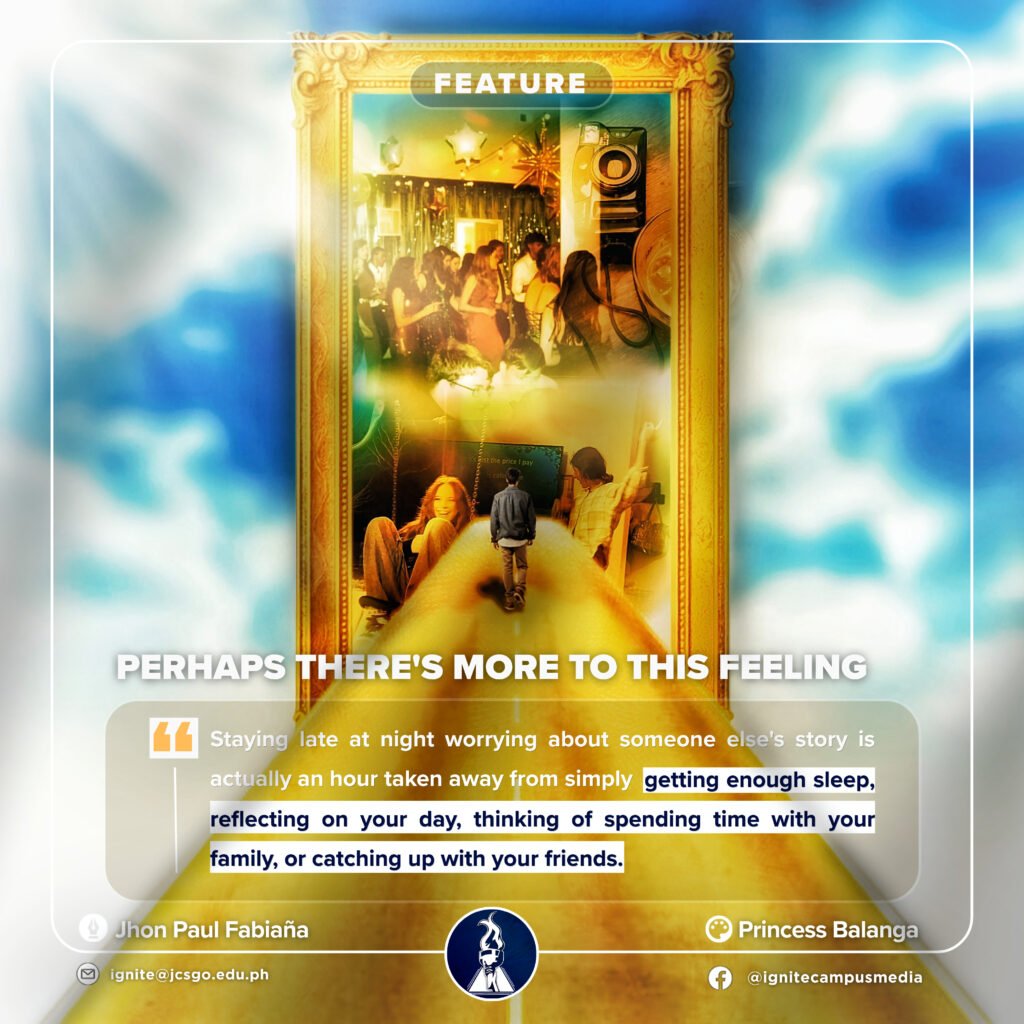
Perhaps there’s more to this feeling
Perhaps there’s more to this feeling
| Jhon Paul Fabiaña
It is almost morning, yet sleep refuses to come. The room is lit by the light coming from your phone. You are doomscrolling through your Instagram feed, then suddenly, a lot of stories and posts appear.
Your classmates were at a coffee shop after a long day of quizzes and performance tasks. Another group is celebrating a debut party. Someone just uploaded photos with someone you want to bond with. You keep scrolling and start wondering why you are falling behind everyone else.
This has become a familiar feeling to many, especially among students. It is not about being overly emotional. Psychologists call it FOMO, or the Fear of Missing Out.
According to researchers at Computers in Human Behavior, FOMO is the constant worry that other people are having fun or meaningful experiences without you. Because of this fear, many people feel the need to stay updated on every notification, story, or post, believing they might miss something important if they look away.
Social media did not create FOMO, but it made the feeling stronger. During the COVID-19 pandemic, when classes shifted online, and gadgets’ screens became the tool for communication, students and even workers spent more time on social media. These apps became their main way of connecting with friends, classmates, and relatives.
Even after schools reopened, the routine stayed. Like a quick scroll through feeds before going to bed became a habit. Now, people compare their ordinary days with photos and videos they see online; they rarely see the ordinary days, disappointments, or struggles behind the camera.
One of the biggest reasons behind FOMO is upward social comparison. In simple words, people compare their everyday lives to the best moments others choose to post online. They don’t realize that their mind is starting to measure an ordinary day against someone else’s post or story.
Sleep Science found that individuals with higher levels of FOMO were more likely to experience poor sleep quality, anxiety, and depression. Meaning, the more people feel pressured to stay connected online, the more difficult it is to rest and focus on themselves.
Did you know that the reason behind this reaction also comes from the brain?
Coach Dinah Salonga, an expert in emotional regulation and a content creator, explained that when people feel left out, the amygdala, which is the part of the brain responsible for detecting threats, becomes active. The brain can still react as if something is wrong, even though social exclusion is not physically dangerous.
It releases the stress hormone cortisol which makes people feel anxious or uneasy. Brain chemicals also influence these emotional reactions: glutamate, which increases alertness, and serotonin, which helps control mood. That is why she encourages people to reflect on whether they truly want to join an activity or if they simply feel pressured because others are participating.
The other face of missing out
Interestingly, there is an opposite feeling that many people experience but rarely talk about. It is the Fear of Being Included (FOBI).
It happens when a person becomes uncomfortable when invited to social gatherings or group activities. Clinical reports describe FOBI as a defense mechanism through a process called devaluation. According to psychologist Dr. Michael Brusten, some people begin to focus on the negative qualities of a group or an event after being included. Their mind quietly convinces itself that the gathering of the people is not worth their time as it first seemed. So, it protects itself from the pressure of belonging.
Now, what if your classmates finally invited you to join them for coffee after a long day? You have wanted to spend time with them, yet the moment the invitation comes out, you begin to hesitate. Because thoughts start racing through your mind… What if they only invited me because they found out I felt that way? What if I do not fit it? Instead of admitting those fears, you begin gaslighting yourself or just imagining things that the café is probably too crowded or expensive anyway, and that you would rather stay at home. The invitation has not changed because it is just your mind simply finding a safer way around.
But there is also a healthier way to respond to these pressures.
Experts describe it as Joy of Missing Out (JOMO). Instead of feeling guilty for staying home or putting the phone away, JOMO encourages people to enjoy where they are and what they are doing, and to make that choice come from their values instead of anxieties.
Choosing JOMO does not mean avoiding people or rejecting friendships. It means choosing peace over pressure. It is realizing that not every invitation needs a yes, and not every trending post deserves attention.
Practicing it also encourages System 2 thinking, a concept introduced by psychologist Daniel Kahneman. Instead of reacting emotionally through impulsive decisions, it allows people to pause and ask whether an activity truly deserves their time and attention. This simple habit helps people focus on what truly matters instead of chasing what everyone else is doing. The decision is no longer driven by FOMO or FOBI, but by what genuinely brings purpose and joy.
At the end of the day, the greatest thing you can protect is your attention. Staying late at night worrying about someone else’s story is actually an hour taken away from simply getting enough sleep, reflecting on your day, thinking of spending time with your family, or catching up with your friends.
Maybe missing one gathering, one trend, or one Instagram story is not really missing out.
Because the moment you stop chasing everyone else’s life is the moment you finally start living your own.