Trying to Build a House Without Bricks
Trying to Build a House Without Bricks
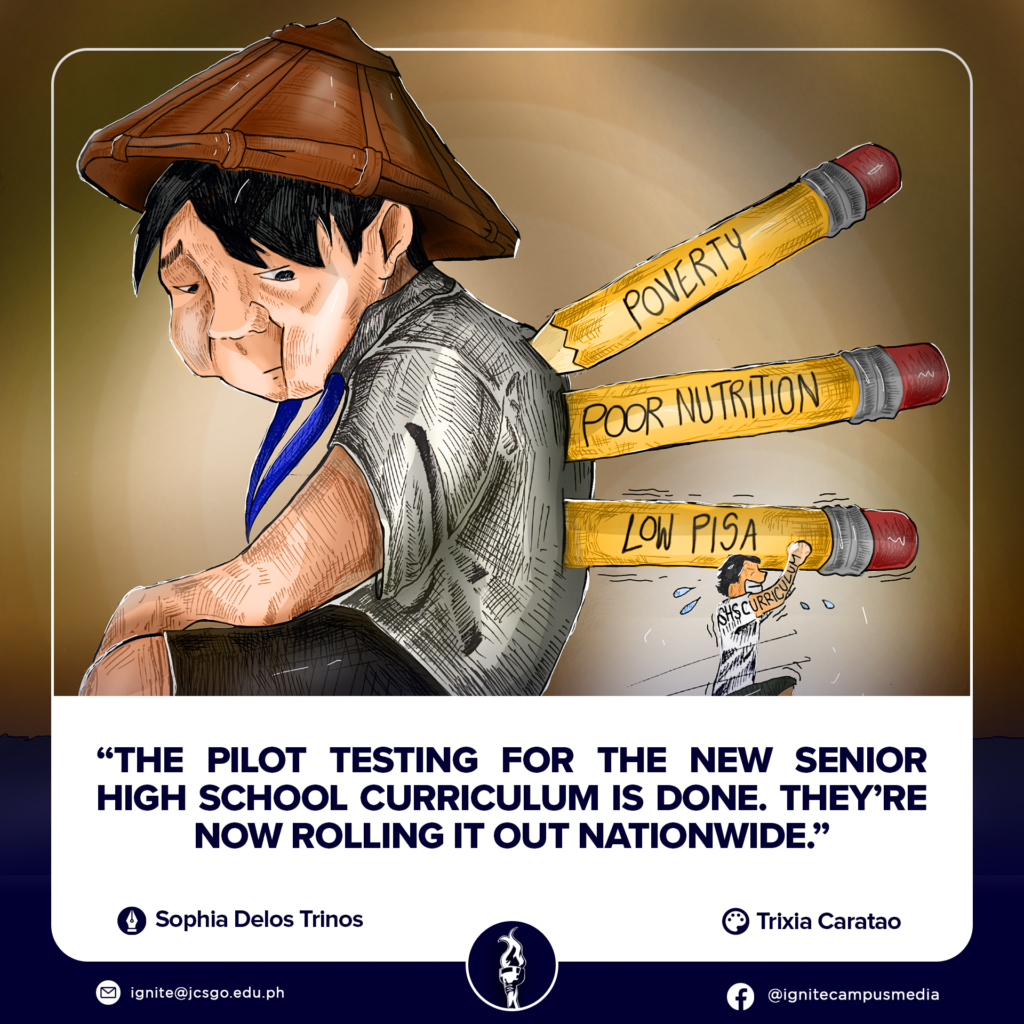
Haven’t you heard the news? The pilot testing for the new senior high school curriculum is done. They’re now rolling it out nationwide.
The new strengthened senior high school curriculum cuts the core subjects from 15 to just five: Effective Communication/Mabisang Komunikasyon, Life and Career Skills, General Mathematics, General Science, and Pag-aaral ng Kaysaysayan at Lipunang Pilipino, putting students into a path that directly goes in line with their desired course and job.
It also halves the tracks students will choose, from four to two: Academic and Technical-Professional (TechPro). The goal is to better align graduates’ skills with the demands of higher education and the workforce.
The change happened because students had too many subjects, the lack of resources, the old curriculum and the labor demands didn’t align, and assessments showed minimal improvements in students.
But there’s an issue.
It threatens the job security of many teachers by removing so many subjects. A “brain drain” happens, where teachers will either leave or be reassigned, affecting students’ learning.
Schools are now forced to comply with the new curriculum even without being ready. Those not part of the pilot run are unaware how to adapt to these changes. It could feel like they’re just going along with the flow.
Talks about revising the grading system, the three term calendar, and this new curriculum overwhelms both teachers and students.
This curriculum change alone can’t fix the issue as long as schools still suffer from classroom shortages, overcrowding, and poverty.
This new curriculum can be great but it is not the absolute solution to students’ struggle with academics. The Philippines’ 2022 PISA scores are incredibly low, resting within the bottom 10 in every category.
The new curriculum is not doomed, yet. The new curriculum combines similar core subjects into one, allowing for students to feel a lot less overwhelmed towards the number of subjects they have to deal with.
The focus should be on students gaining the proper nutrients, the necessary foundation of learning and academic success and not rebranding the senior high school curriculum.
Proper nutrition is crucial for cognitive function, affecting concentration, memory, and behavior. In the Philippines, 1 in 2 children under five years old are malnutritioned, with 13% in more severe food poverty.
This affects students’ performance and proficiency. Lacking the energy to learn, and to grasp their lessons. Filipinos are struggling with their academics, and the solution should be to solve the problem from its very roots, not when it’s already done growing.
Proper nutrition should be the focus of the Philippines, it leads to higher scores, higher focus. Even if you refine the curriculum a hundred times, it provides no positive effects if students are unable to even focus while at school.
This new curriculum is a step forward, but won’t be the reason proficiency rates increase.
It only provides a framework that still needs effective execution for student proficiency rates to increase to the target 90% compared to the current 0.40% from the National Achievement Test (NAT).
The blueprint has now been altered, it now lies on whether or not the country can provide the bricks for students to truly learn. Because a sturdy house needs a good foundation, just like how a student needs proper nutrients for excellency.
Students should not be afraid to voice their concerns, the instability of the new curriculum, the uncertainty of the future of education.
Your education is your future. As the country’s future leaders, and future workers. You have to speak up about what’s working, what’s lacking, and what is needed.